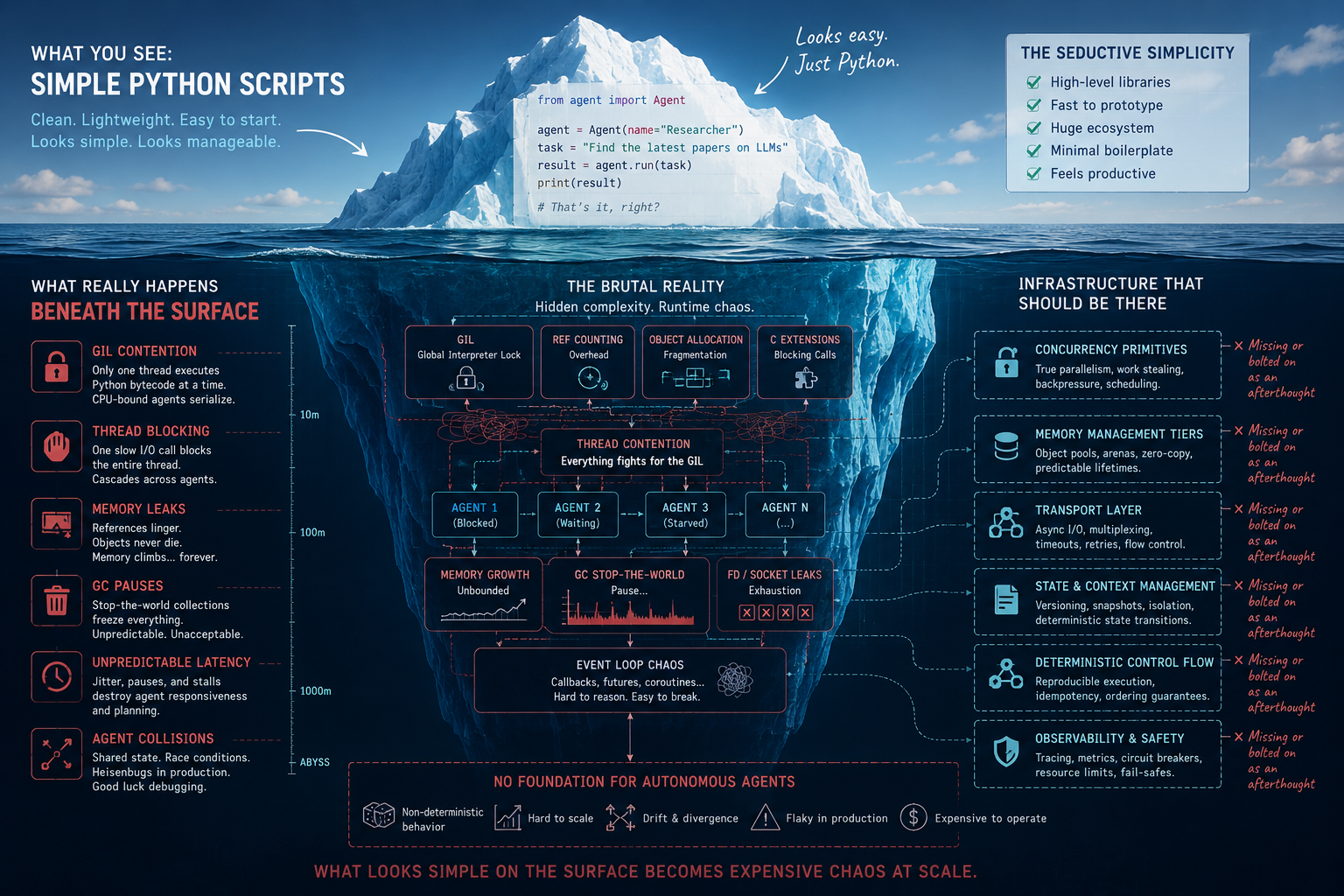
The Category Error
Every framework in this space calls itself an “agent framework.” None of them are — not in the way that matters for production systems running headlessly, at scale, on real infrastructure.
The difference is architectural. It starts with a single constraint: Python cannot compile to a native executable.
That sounds like a technical detail. It’s actually a disqualifier. Python can’t cold-start in milliseconds. It can’t run on edge hardware without dragging an interpreter. It can’t get lean enough for dense, concurrent agent deployment at scale. This isn’t a feature gap that gets bridged with better engineering. It’s a categorical limitation baked into the language choice itself.
Cold Start Time Is Not Optional
When an agent system needs to spin up fast — when a node fails and you need instant failover, when you want to run on a Raspberry Pi in an air-gap facility, when you are scaling a swarm across dozens of short-lived processes — cold start time determines what is actually possible.
Python interprets at runtime. Every invocation includes the interpreter overhead: class loading, module initialization, object instantiation. A bare Python script takes 100 to 300 milliseconds just to start before doing any actual work. Add LangChain or CrewAI, and you’re looking at several seconds of cold start time before the first LLM call even happens.
GraalVM Native changes this fundamentally. When you compile a Kotlin application to a native executable, the JVM boots in microseconds, not seconds. The same AWS Lambda function that took 3.6 seconds to cold-start under the JVM starts in under 100ms as a native executable. That is not a 10% improvement. That is the difference between an architecture that can handle bursty, event-driven workloads and one that chokes on them.
Memory Footprint Changes What Is Deployable
The memory footprint tells the same story. Native images ship with only the runtime classes actually used by the application, which cuts memory consumption dramatically compared to a full JVM with all its classloading infrastructure. A Spring Boot application that consumed 512MB under the JVM drops well below 128MB as a native image.
This is not a nice-to-have for headless deployment. This is the baseline requirement.
When you are running headless agents, you need state that survives restarts because there is no human re-initializing context every time a process restarts. You need thread-safe concurrent writes because multiple agents act simultaneously without corrupting shared state. You need fault tolerance that handles node failures without human intervention because the system runs unattended, which means infrastructure failures occur without manual recovery.
Python’s interpreter architecture cannot provide any of these at the substrate level. Not because the frameworks built on Python are poorly engineered — but because Python’s fundamental architecture makes it incompatible with what headless operation actually requires.
Why Python Cannot Be a Substrate
An agent substrate requires native compilation as a baseline capability. Not because native is inherently better, but because headless operation demands it.
Here’s the chain of reasoning. Headless agents need sub-100ms cold starts so a swarm can recover from node failures in milliseconds, not seconds. Python’s minimum cold start is 100-300ms before any application code — just the interpreter overhead. This makes sub-100ms cold starts categorically impossible in Python, not just difficult.
Headless agents need lean memory footprint because dense concurrent deployment on modest hardware requires efficient memory use. Python’s object model carries significant metadata overhead on every allocation. Native compilation eliminates this overhead because the binary includes only what the application actually uses.
Headless agents need deployment flexibility. Edge devices, air-gap facilities, IoT hardware — these deployment targets cannot run the full Python interpreter stack. A native executable can run anywhere. A Python application needs Python installed, configured, and available on every target.
These are not preferences. They are the baseline. You cannot build a substrate in a language that cannot provide what headless operation actually requires.
What TPipe Provides
TPipe was not designed as a Python library you drop into an existing project. It was designed as a managed operating environment for AI agents that run headlessly, at scale, on real infrastructure.
Built on Kotlin and the JVM. Today, TPipe runs as java -jar TPipe-*.jar on JVM 24. GraalVM Native Image ships as a 50MB binary — no JVM at runtime, sub-128MB memory footprint, millisecond startup, ARM and mobile targets (.so for Android, .dylib for iOS). The same architectural constraints Python cannot meet are the ones GraalVM Native Image addresses.
The substrate itself — independent of the deployment target — is what gives TPipe the production properties Python frameworks cannot provide:
- PCP (Pipe Context Protocol) handles multi-language sandboxing — agents written in Kotlin, JavaScript, or Python execute in the same pipeline with security boundaries between them
- ContextBank handles persistent global memory — state survives restarts and is accessible across distributed nodes
- Token counting + truncation (ContextWindow, LoreBook, MiniBank, Dictionary) enforces memory budgets at the resource level. Tunable per-model tokenizer with TPipe-Tuner. This is memory resource management, not termination.
- KillSwitch is the separate safety net — an uncaught exception thrown when accumulated tokens exceed a configured cap. Cannot be caught and ignored. Propagates through the container hierarchy.
- P2P (Pipe to Pipe) handles direct agent-to-agent communication with no central coordinator
- DistributionGrid handles decentralized swarm behavior that survives individual node failures
The native compilation target is not an afterthought. It is part of the core design from the first architecture decision. The build file explicitly targets GraalVM Native Image, designed for deployment as native binaries to edge devices, IoT systems, and mobile platforms — environments where the interpreter overhead would be disqualifying.
This Is Not a Feature Comparison
This is not an argument that TPipe has better abstractions or more elegant APIs. Those are preference questions. The substrate tier is not a preference question.
Either your architecture can run headlessly at scale, or it cannot. Either your agents can recover from node failures in milliseconds, or they cannot. Either you can deploy to edge hardware and air-gap environments, or you cannot. These are binary outcomes, not gradients.
Python frameworks cannot cross the substrate threshold because Python cannot cross it. The language architecture and the substrate requirements are incompatible.
TPipe crosses the threshold because Kotlin on the JVM with GraalVM Native Image was designed to cross it. The rest follows from having a runtime that can actually support what substrate operation requires.
See Also
See the full LangChain comparison
The substrate distinction between TPipe and LangChain goes deeper than features — it's architectural. TPipe's GraalVM native compilation, P2P agent communication, and ContextBank persistence aren't options available to Python-based frameworks. See the complete breakdown to understand what's actually different and why it matters for production.
See TPipe vs LangChain comparison →That is the architectural difference. Everything else is implementation.
Related posts
- Reasoning Pipes Explained: How TPipe Stops Prompting and Starts Programming — The Kotlin
Nothingtype used in reasoning pipe callbacks is one example of a feature Python’s type system cannot express. The whole post builds on Kotlin affordances Python cannot replicate. - Why P2P Agent Communication Is Inevitable — The P2P architecture requires transport abstractions, registry concepts, and security boundaries that Python’s object model cannot provide.
- What Is an Agent Substrate — The conceptual foundation. The substrate is what makes headless, deterministic, multi-agent systems possible. Python cannot host it.
- The KillSwitch: Token Budgets That Actually Kill the Agent — The 66-line Kotlin file that ends with
throw. TheNothingreturn type, the uncaught exception, the catch-and-rethrow carve-out. None of this translates to Python.