The LLM-as-Brain Problem
When large language models arrived, the temptation was immediate: treat them as brains. Give them memory. Give them tools. Give them reasoning capability. Let them decide what to do next. This is the dominant paradigm in contemporary AI agent frameworks, and it is an architectural mistake that compounds at scale.
The problem is not that these systems fail in demos — they work fine there. The problem is that they fail in production: predictably, expensively, in ways that are difficult to debug. Three failure modes dominate.
Non-determinism. The same input produces different outputs. A prompt that worked yesterday fails today. The LLM produces different responses because it is a stochastic system optimized for fluent text generation, not for consistent task execution. Enterprise systems require reproducibility. If the same customer query produces two different quality levels, you have no quality guarantee.
Cost explosion. Every LLM call is expensive. When the LLM handles structural work — deciding which tool to call, managing memory context, orchestrating sub-tasks — you burn tokens on administrative overhead rather than actual value. Current frameworks routinely produce pipelines that cost ten times more than necessary because the LLM is doing work that infrastructure should handle.
Loss of control. Once an LLM-as-brain agent starts running, it is a black box. You cannot pause it mid-execution, inspect its state, and decide to intervene. You cannot retry from a specific checkpoint. You cannot jump to a different stage. Debugging means reading through opaque inference logs and hoping you can reconstruct what happened.
These are not edge cases. They are architectural consequences. The LLM was trained for next-token prediction on a vast corpus of human-generated text. It was never designed to manage its own memory, coordinate tool execution, or reason about complex multi-step workflows. When you assign these responsibilities to the model, you inherit all the unpredictability that comes with them.
The alternative is straightforward: treat the LLM as what it actually is. A prediction engine that produces the next token given context. Structure the system so that orchestration, memory, and governance are handled by infrastructure. The LLM’s only job is answering the current question, nothing more.
What a Substrate Actually Is
A substrate is a managed operating environment for AI agents. The distinction from a library matters: a library provides functions you call; a substrate provides an environment your agents inhabit. Think of the difference between running processes in an operating system versus writing standalone scripts. The OS does not just provide functions — it provides isolation, memory management, scheduling, and control. A substrate does the same for AI agents.
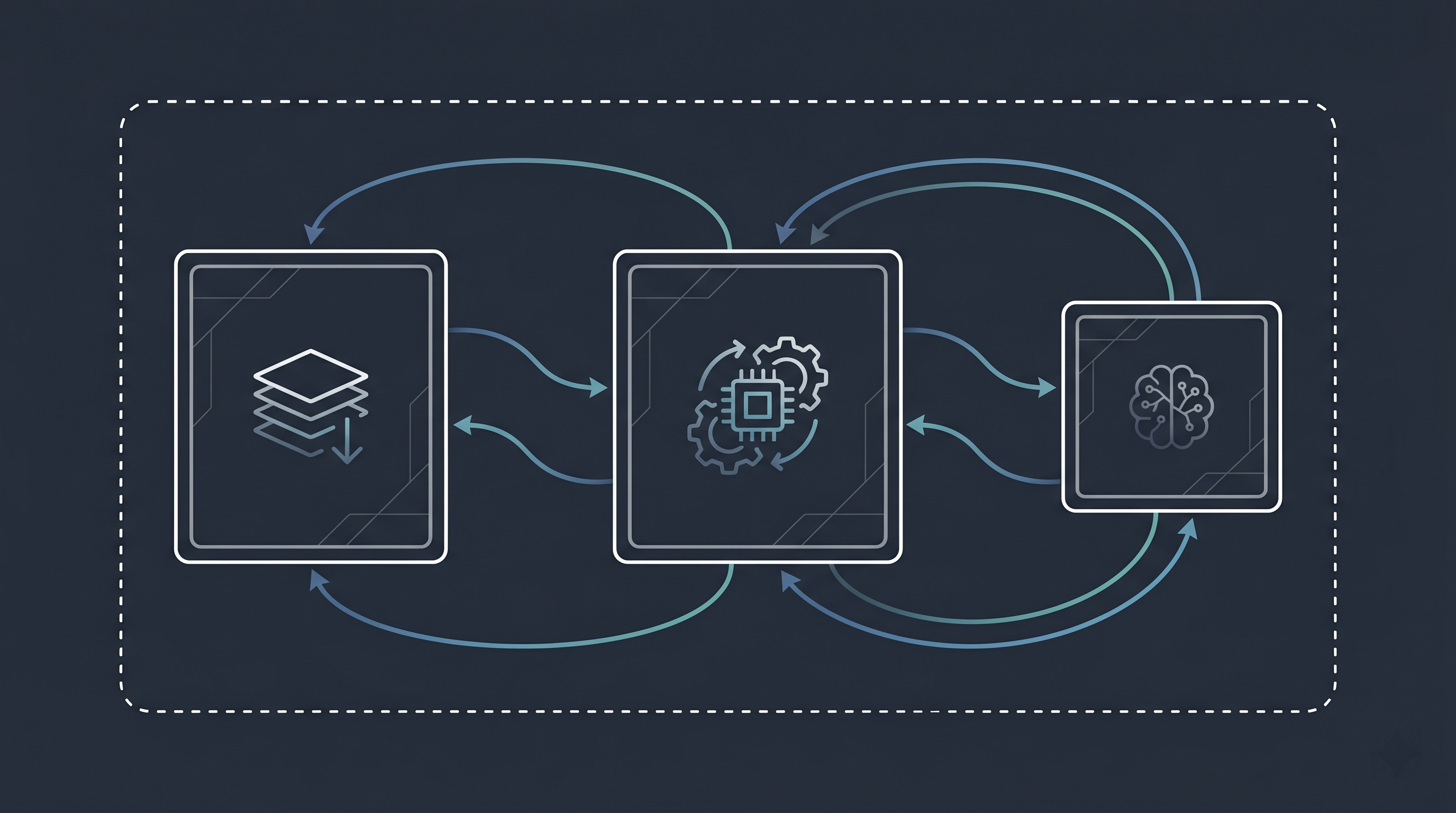
In a substrate architecture, the LLM is one transition function in a state machine, not the brain of the system. The state machine handles orchestration. Infrastructure handles memory. Protocols handle tool execution. The LLM receives a well-scoped prediction task, produces its output, and the substrate manages everything else.
Consider what a substrate actually provides: pause/resume/jump control so you can inspect and redirect execution at any point; token budget enforcement so costs are governed top-down, not estimated bottom-up; persistent memory across restarts so agents remember what they learned last week; trace reports that capture every decision for audit purposes. These are operating system concepts applied to AI orchestration.
The LLM-as-brain paradigm treats the model as an autonomous agent. The substrate paradigm treats the model as infrastructure. The distinction determines whether your system behaves like reliable software or like an unpredictable oracle.
The Pipe as Unit of Work
The fundamental unit of work in a substrate is the pipe — an enclosed runtime that contains everything a single LLM call needs. Model configuration. System prompt. Memory scope. Token budget. The pipe is fully isolated. You can pause it, inspect it, and reason about it in complete detail.
The distinction between a pipe and a node in a graph is critical. A node in a conventional agent graph is a step in a workflow — it receives data, processes it, passes it to the next node. A pipe is not a node. A pipe is an entire agent with its own runtime. It is closer to a Unix process than to a function call.
When you compose pipes into pipelines, you are not wiring together nodes in a graph. You are chaining independent agents through a controlled flow. The output of one pipe becomes the input of the next. Conditional branching uses explicit control flow, not unpredictable model decisions. Validation functions can redirect flow mid-execution using setJumpToPipe(). The system behaves like software, not like inference.
The LLM’s role in this architecture is precisely scoped. The model makes one single abstract prediction: given this context, produce the next output. It does not decide what to do next. It does not manage its own memory. It does not orchestrate sub-tasks. The substrate handles all of that. The LLM focuses entirely on prediction.
This separation mirrors what early Unix got right. In Unix, each program does one thing well. Programs are composed through pipes, not embedded inside each other. The pipe is the abstraction that enables composition. ls | grep | sort | head — five programs, one purpose, zero coupling. Each program is simple. The composition is powerful.
TPipe applies the same principle to AI orchestration. Pipes are specialized tools that do one thing well. They are composed through pipelines. The LLM is the engine inside each pipe, not the brain of the system. This is what makes the architecture work: the model does what it was designed to do, within an environment built for reliability.
Memory as Infrastructure
In the LLM-as-brain paradigm, the model manages its own memory. It decides what to store, what to retrieve, and how to weight relevance. It burns tokens on memory operations that infrastructure should handle, and it produces inconsistent results because memory management is not what the model was trained to do.
A substrate treats memory as infrastructure. TPipe implements a three-tier memory model: ContextWindow, ContextBank, and LoreBook.
ContextWindow is per-run memory scoped to a single pipeline execution. It is ephemeral, discarded when the run ends. The substrate truncates it automatically to fit within enforced token budgets. The LLM has no awareness of this process; it simply receives the context that fits.
ContextBank is persistent memory that survives process restarts. Agents remember what they learned last week, last month, or last year. The substrate handles serialization and retrieval. The model does not manage this persistence — it simply receives relevant context when it runs.
LoreBook is weighted recall with dependencies and linked keys. When the input mentions Q3 report, LoreBook automatically includes the financial-data entry because they share a link. The substrate handles the matching, weighting, and injection. The model focuses entirely on prediction.
The architectural principle here is separation of concerns. Memory is a storage problem. Prediction is a modeling problem. Conflating them in the LLM produces neither storage nor prediction well. The substrate handles storage; the model handles prediction. Each component does what it is designed to do.
When the LLM receives context from LoreBook, it has no awareness of where that context came from. It produces a prediction on the task it is given. The memory lookup burden — deciding what to retrieve, how to weight it, how to integrate it — is handled by infrastructure before the LLM ever sees the input.
Determinism Through Structure
Enterprise compliance requires reproducibility. The same input must produce the same output, every time. Audit trails must capture what happened, not just what the model said happened. When something goes wrong, you must be able to pause, inspect, and understand.
LLM-as-brain architectures cannot provide this. The model is a stochastic system. Even with temperature set to zero, subtle floating-point variations across long contexts can produce different outputs. The model decides what to do next, which means you cannot predict what it will do next. Non-determinism is baked into the architecture.
Substrate architecture provides determinism through structure. TPipe pipelines are not black boxes. You can pause at any point, inspect state, modify context, and resume — or jump to a different stage entirely. Validation functions can call setJumpToPipe() to redirect flow based on conditions you define. Trace reports capture every decision, every context injection, every token budget enforcement.
Token budgets are enforced, not estimated. The TokenBudgetSettings class allocates space for context and generation. When the budget is exhausted, the substrate truncates rather than allowing unbounded growth. You know exactly how many tokens each operation consumed because the substrate tracks it.
The same input reliably produces the same output. This is not because the LLM is deterministic — it is because the substrate governs everything that affects determinism: token allocation, context injection, sampling parameters. When you control the environment, you control the output. Reproducibility is an architectural property, not an emergent behavior.
For enterprise deployments where audit trails are required, where regulators demand reproducibility, where a single input must produce a single output for legal or contractual reasons — substrate architecture provides foundations purpose-built for these requirements.
Developer-in-the-Loop: Direct Interface to the Runtime
Conventional agent frameworks offer hooks, but these hooks are limited: a string you can modify before it reaches the LLM, a bash script you can run after. These are superficial interventions into a process you do not control.
TPipe’s Developer-in-the-Loop (DITL) hooks are different. They are direct interfaces to the substrate itself, not string manipulators bolted onto the periphery. Because the pipe contains the entire runtime environment, DITL hooks give you direct access to that environment: its state, its objects, its execution context.
Structured output, not strings. When the LLM produces output in a conventional framework, you receive a string. You parse it, hope it matches your expected format, and handle errors when it does not. In TPipe, you receive a well-defined object in memory. The output is already structured — parsed, validated, typed. You work with it as you would any object in your program. This is the difference between processing text and processing data.
Host program state integration. Your program using the substrate is not a passive observer. DITL hooks give you access to your own program state at any point during execution. You can inspect what your program has done, what data it has access to, what decisions it has made. The substrate is not an island — it is an extension of your program’s execution context.
Full runtime introspection. When you pause a pipe, you can inspect its complete state: the model configuration, the system prompt as it exists after all processing, the current context as the LLM sees it, the memory entries that were selected, the token budget as it stands. You are not looking at a log or a summary — you are looking at the actual runtime state of an isolated execution environment.
Direct interference, not callbacks. DITL hooks let you interfere directly with the runtime. You can modify context before the LLM receives it. You can transform output after the LLM produces it. You can redirect flow based on conditions you evaluate in your own code. You can inject data from your program into the pipe’s memory. The pipe is not a black box you observe — it is an open system you control.
This is what it means to treat the LLM as infrastructure: the substrate provides the execution environment, and you have complete access to that environment. The LLM produces predictions. You provide the context, interpret the output, and direct what happens next. The architecture is not LLM-as-brain — it is LLM-as-component, with you as the orchestrator.
Why This Architecture Works
The substrate paradigm works because it respects what an LLM actually is: a prediction engine, not a brain, not an agent, not a system with its own intentions. It produces the next token given context. It was never designed to manage memory, orchestrate tools, or reason about multi-step workflows.
Early Unix got this right. Programs are specialized tools that do one thing well. They are composed through pipes. The OS handles memory, scheduling, and control. Programs focus on their specific task. This separation is what made Unix powerful: each component does what it was designed to do, within an environment built for reliability.
TPipe applies this same principle to AI orchestration. The LLM is the engine inside each pipe, not the brain of the system. The substrate provides the operating environment: memory persistence, protocol enforcement, resource governance, deterministic control. The LLM provides predictions within enforced constraints.
The architectural shift: LLM as process, not brain. The LLM’s only job is producing the next prediction. Everything else — memory, orchestration, resource governance — is structural. When you build on these foundations, you get systems that are auditable, deterministic, and cost-controlled.
The architectural conversation is shifting toward substrate design. Enterprise architects and technical leads have seen what happens when you treat LLMs as autonomous agents: non-deterministic outputs, cost explosions, and black boxes that cannot be audited or controlled. They are calling for a different approach, one where AI systems behave like reliable infrastructure rather than unpredictable oracles. TPipe is the first and only agent substrate to implement this architecture in production.
The substrate paradigm is not a feature — it is a foundation. It changes what is possible. If you are building AI systems where correctness matters, where audit trails are required, where token budgets need enforcement, and where the same input must produce the same output reliably, the substrate paradigm provides the architectural basis you need.
Next Steps
- Read the LLM Fundamentals article to understand the prediction-engine nature of LLMs in depth
- Explore the Pipe Class documentation for detailed configuration options
- Understand the three-tier memory model in depth
- Build your first pipeline with the Quick Start Guide
If you want production-ready AI agents that behave like reliable infrastructure rather than unpredictable oracles, the substrate paradigm is where you start.